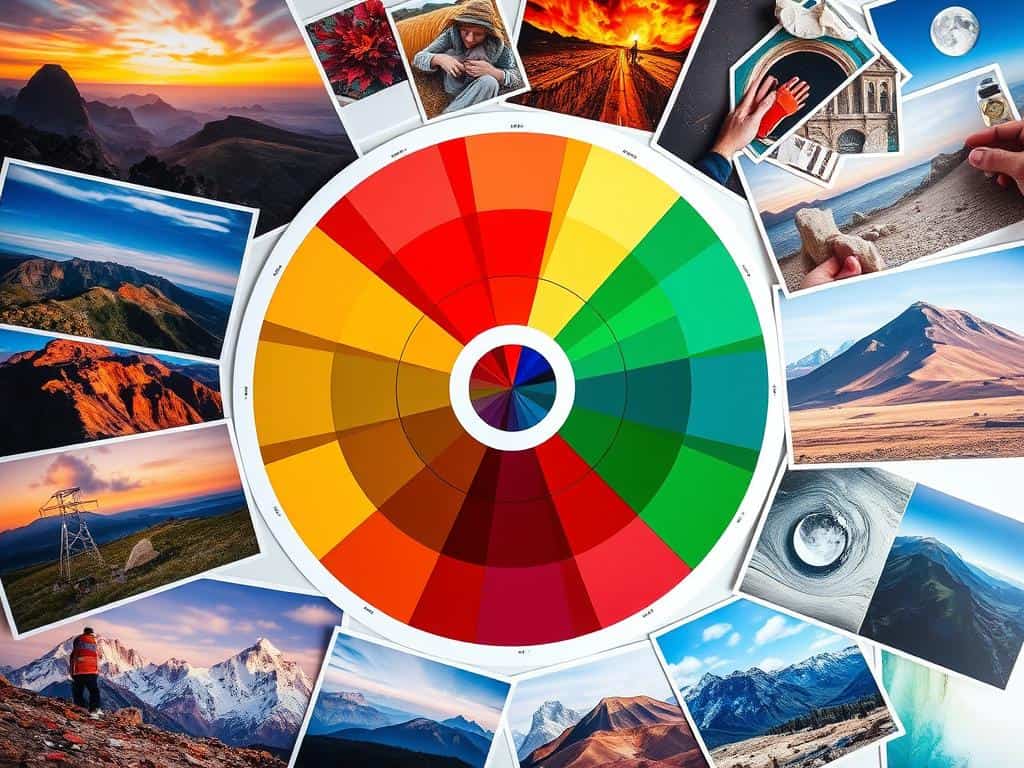

Did you know that knowing about complementary colors can make your photos pop? By mixing colors like blue and orange, you can create stunning contrasts. This is a key part of color theory for vibrant photos.
Creating captivating pictures involves using color theory for photographers wisely. By understanding how colors work together, you can make your images stand out. For example, using both warm and cool colors in one shot can make it more dynamic. This makes even simple scenes look more colorful.
In photography aesthetics, the right colors can turn a simple photo into a story. Whether you want to show excitement with reds and oranges or calmness with blues and greens, knowing color harmony is key. Adjusting colors like hue, saturation, and brightness can also make your photos more vibrant and telling.
Key Takeaways
- The color wheel shows how primary, secondary, and complementary colors relate.
- Mixing warm and cool colors adds depth and vibrancy to your images.
- Using complementary colors creates striking contrasts, essential for vibrant photos.
- Editing tools like saturation and vibrance sliders can boost specific colors without losing balance.
- The golden hour’s soft light greatly improves the colors and textures in your photos.
The Fundamentals of Color Theory
Color theory is key to making photos look good. The color wheel is a main tool for this. Sir Isaac Newton made it in 1666. It shows how colors work together, including primary, secondary, and tertiary colors.
Understanding the Color Wheel
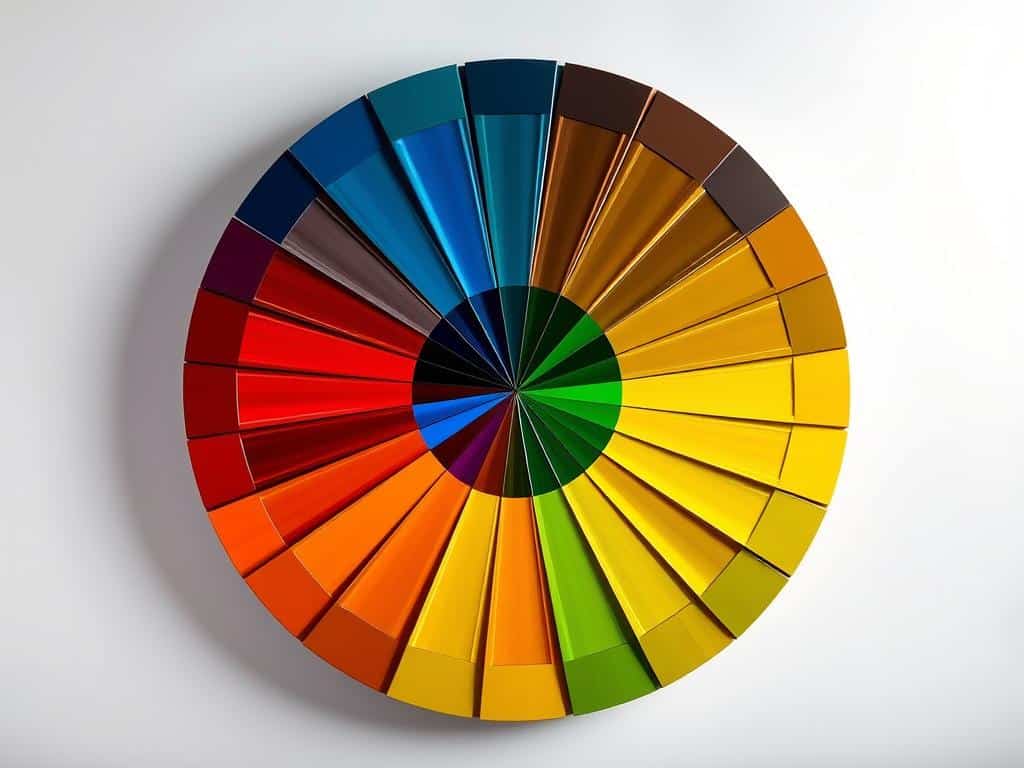
The color wheel helps us see how colors mix. Red, blue, and yellow are the primary colors. Mixing these makes secondary colors like green, orange, and purple. Adding more, we get twelve colors on the color wheel.
Color Harmony Basics
To get color balance right, you need to know color harmony. Complementary colors, like blue and orange, make a strong contrast. Analogous colors are next to each other and are calming.
Split complementary schemes use a base color and its two neighbors. Triadic colors are three colors apart and lively yet balanced.
Warm vs. Cool Colors
Knowing warm and cool colors changes a photo’s mood. Warm colors like red, orange, and yellow feel energetic. Cool colors, like blue, green, and purple, are calming.
Using both warm and cool colors lets photographers control the mood. This makes photos more engaging and emotional.
Color Theory for Photographers
Color theory is a powerful tool for photographers aiming to elevate their visual storytelling. By understanding how to balance colors in compositions and utilizing color to lead the eye, photographers can significantly enhance the viewer’s experience.
Balancing Colors in Your Composition
Balancing colors within a photograph starts with a solid grasp of the color wheel. Using complementary colors, which are directly opposite each other on the wheel, can create striking, vibrant contrasts. For example, the rich oranges and yellows of a New England autumn serve as an excellent demonstration of analogous colors—those that sit next to each other on the color wheel. This balance can reduce visual tension while boosting visual harmony and color impact.
Using Color to Lead the Eye
Effective visual storytelling also involves using color to naturally guide the viewer’s eye through the image. Bright or contrasting colors can draw attention to the subject, while softer gradients provide a smoother visual flow. For example, placing a vibrant subject against a more neutral background can make it pop, directing the viewer’s attention exactly where you want it.
Creating Mood with Color
Colors wield the power to evoke emotions, making them key tools for creating mood in photography. Warm tones like reds and oranges can provide a sense of energy and positivity. In contrast, cool tones like blues and greens can set calm, reflective atmospheres. Adjusting saturation and luminance in editing software allows for the fine-tuning of these emotional elements, ensuring that the emotional resonance in photography is both impactful and precise.
Conclusion
Color theory is key for mastering photography. Knowing the color wheel and using color schemes like complementary and analogous can make your photos better. Up to 93% of people judge products by how they look, showing how important color is.
Colors can make your photos feel more emotional and impactful. Using warm and cool colors can set the mood. Photos with balanced colors can keep viewers interested for up to 75% longer.
Learning about color theory is a journey. It helps you create photos that are not just pretty but also touch the heart. By understanding color, you can make your photos stand out and connect with people on a deeper level.
